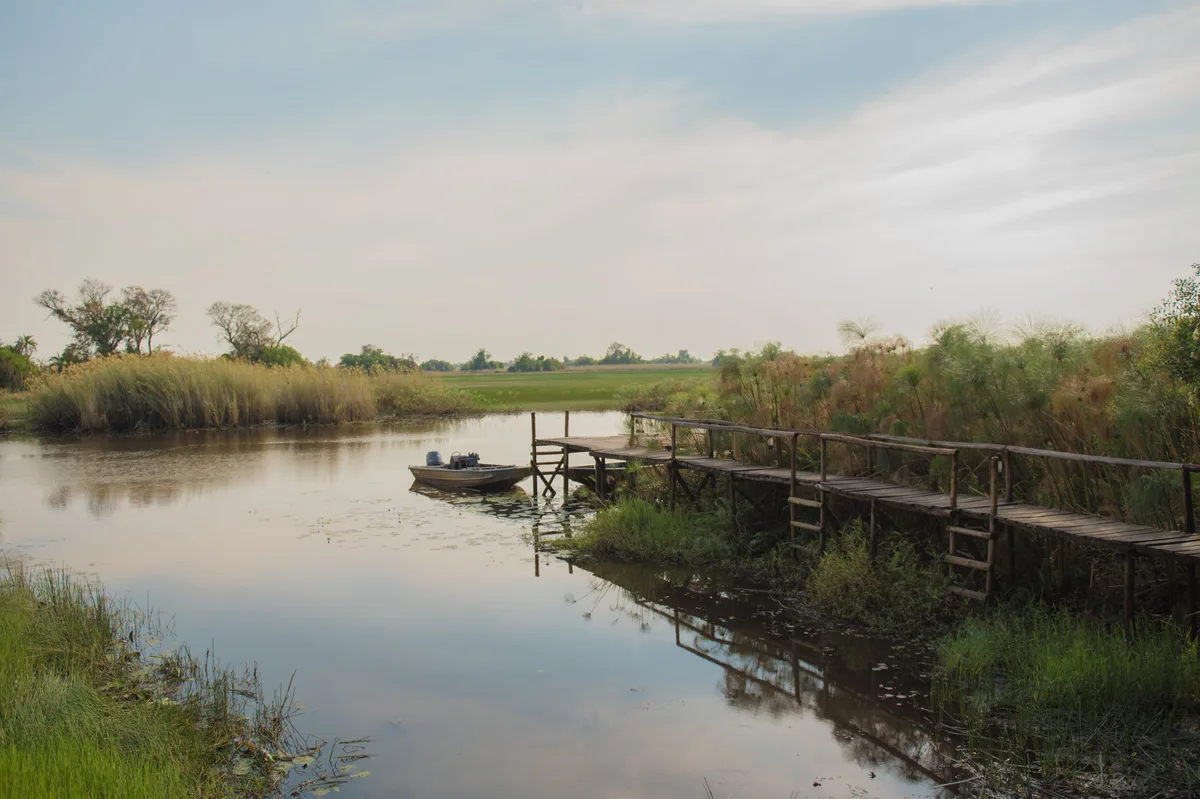
At first light on the Boro channel, the water is cold enough to steam gently against the reeds. Our poler, Keabetswe, steps onto the stern of the fibreglass mokoro with the unhurried balance of someone who has spent twenty winters reading this current.
There is no engine. For three days, the only sounds are the dip of the ngashi pole against sandbars, the rattle of reed frogs, and the distant cough of a hippo somewhere behind a wall of papyrus.
"When you travel at the pace of a pole in the sand, the delta stops being scenery and starts becoming a neighbourhood."
Most visitors see the Okavango from forty feet up in a Cessna or from the raised bench of a Land Cruiser. Both have their place, yet neither teaches you how the flood arrives. Rain that fell in the Angolan highlands in January reaches Maun in June, turning dry acacia islands into temporary archipelagos just as southern Africa enters its dry winter.
Following the water
We camp on small palm islands where elephant paths double as footpaths. Before dusk, Keabetswe walks the perimeter to check fresh spoor while tea boils over leadwood embers. Nothing here is fenced, and nothing is rushed.
By the third morning, the channels narrow into shallow floodplains dotted with water lilies. Here, travel planning is simple: come between June and September when the flood peaks, fly into Maun, and give yourself at least three nights on the water so the rhythm has time to settle.